Become a member of Internet Archive! Human to human..
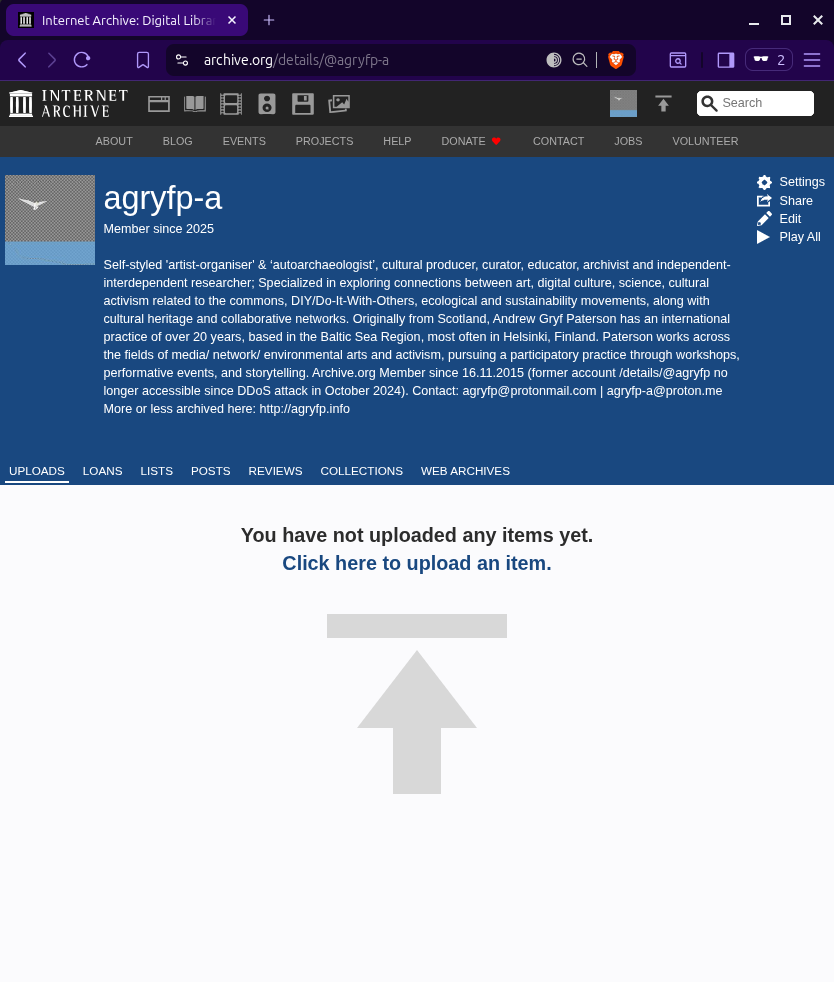
My former Archive.org account /details/@agryfp has not been accessible since their DDoS attack in October 2024.. So on the 10th Anniversary of that 1st upload, I finally re-start my archival practice to Internet Archive's Cultural /Knowledge /Information Commons t/here: https://archive.org/details/@agryfp-a
It took a little thought what identity do I wish to claim again on Internet Archive, especially as I have maintained 'digital avatar coherency' for 25+ years as 'agryfp'; and I wish to transfer my old account materials to this new one [Aye, the artefacts uploaded still exist online via a search inquiry, but I cannot edit, delete, or adjust the metadata; ]..
So I use the additional '-a' which is a Basic UNIX command Ls behavior: "lists all files, including the ones whose filenames begin in a dot, which you do not always want to see." In the context of what investigative journalist Carole Cadwalladr calls The Great AI Bubble, as cultural workers and activists for the Commons we need to think about our role(s) in the extracted and exploited environment of open culture and knowledge. Initiators of open ecosystem platforms, as well as the critical ICT circles around them, know that Large Learning Model (LLM) machine-learning, forming the basis of current AI tools has been trained with open-access materials, including Internet Archive accounts, Creative Commons -licensed media, and content on Wikimedia platforms, such as Wikidata. These platforms are aware of the challenges ahead.
We (still) have a role to play to contribute to human-led cultural production online. As a commons activist, happy to acknowledge my inspiration and borrowing from and interdependence among others -in-other-words, our cultural inheritance as living beings sharing the world and our environments with others- and I am happy to give, sustain and fight for platforms that allow us to share media and files beyond the commercial, extractive and for-profit sphere. It is a enlightening matter, actually..
There are dark forces extracting living human energy and their produced data, metadata, artefacts, related paradata and knowledge. via spiderbots, algorithms, and 'learning machines', on an unprecedented scale, after several decades of mass sharing of personal data and media online in participatory platforms. This is done supposedly for the benefit of all of us, but we were not asked how and for what reason. We are in the age of the so-called 'Web 4.0' (If the original WWW is 1.0; 2.0 social-; 3.0 semantic-; now machine-learning/AI-). What is becoming increasingly clear is that much of this is done for privatized profit gain to the benefit on a small number of humans. What Cadwalladr call the 'broligarchy'. Others, such as Jodi Dean speak of neofeudalism and the new class struggle which we live in now, and which is projected to be increasingly so in the future. If we are not careful the developments of Web 5.0 will likely step towards 'necro-' (death)..
Meanwhile, on October 31th, 2025, Internet Archive recently celebrated one trillion webpages archived. It was described as a "civilization-scale milestone". The archiving of webpages, and the popular tool Wayback Machine, is a powerful tool to maintain a connection to the early Web 1.0, a reminder of early promises of connections and creativity beyond borders. Algorithms and machine-learning can be applied also for the good, to the benefit of public memory institutions, as applications working with GLAM (galleries, libraries, archives, museums). Note, the Finnish special interest group AvoinGLAM (of which I am also attached to) reallocates that acronym also to "global languages, art and memory". How will we remember our own culture and pasts now in this contemporary digital network era, and how about in the future?
It is a counterpoint to what a recent group panel celebrating the 'open web' called the "three Cs" -centralization, copyright, and competition- that is a feature of so-called 'Web 2.0' and now 'Web 4.0'. Cory Doctorow's coined term 'Enshittification' in January 2023 has now been applied generally to the rise, development and decline of the entrepreneur-turned-Corporation model of online platforms over the past 20 years; "Or how, exactly, platforms die."
Platforms that exist to enable the Internet and Creative Commons, such as Internet Archive, are under threat from the "three Cs". The copyright lawsuit case that Internet Archive is facing in the USA still ongoing. The DDoS attackers of October 2024 are to my knowledge still unknown. The Internet Archive and tools like the Wayback Machine are powerful as they maintain witness. They hold our valuable knowledge and make it accessible. Not everyone, and especially those who wish to extract value from life, the neofeudalists, the one who rent or offer for free digital 'land' to grow, with a heavy price to pay in life energy and cognitive attention.
Let's take care of each other, and the outcomes and outgoings of digital humanities. Acknowledge the role of the Commons as you can. Become a member of Internet Archive. Join in and contribute what you can and wish to exist in the future. Human to human. Before it is too late, and the service and accounts are sabotaged. Or errors made as 'sticks in the wheel', inserted by machine actions instead of yours. Ours.